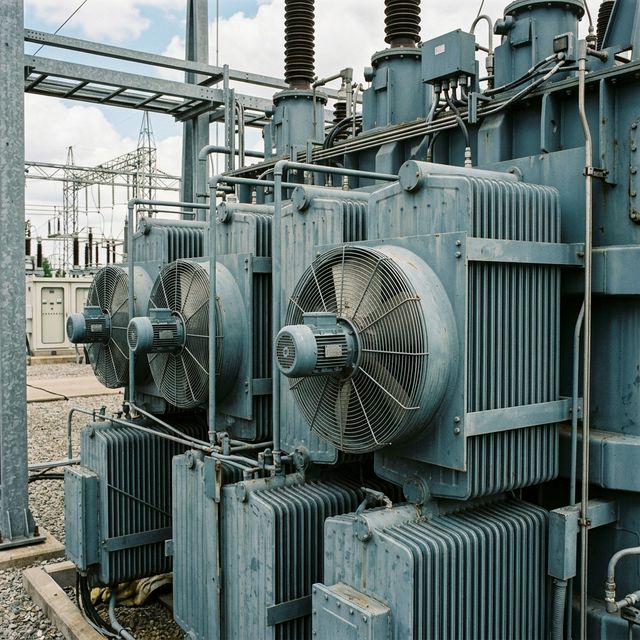
The cooling system is one of the most critical aspects of transformer design. It directly affects the transformer's rated capacity, efficiency, and service life. Understanding cooling methods helps engineers specify the right transformer and operate it within safe limits.
Why Cooling Matters
Transformer losses (no-load and load losses) generate heat. Excessive heat accelerates insulation aging following the Arrhenius equation — for every 6°C above the rated hotspot temperature, insulation life is halved.
Cooling System Designations
The IEC 60076-2 standard uses a four-letter code:
| Position | Meaning | Options |
|---|---|---|
| 1st letter | Internal coolant | O = Oil, K = Ester |
| 2nd letter | Internal circulation | N = Natural, F = Forced, D = Directed |
| 3rd letter | External coolant | A = Air, W = Water |
| 4th letter | External circulation | N = Natural, F = Forced |
Common Cooling Methods
ONAN (Oil Natural, Air Natural)
The simplest and most common method:
- Oil circulates by natural convection (thermosiphon effect)
- Heat dissipated through radiator fins to ambient air
- Used for transformers up to ~30 MVA
- No pumps or fans — completely silent external cooling
ONAF (Oil Natural, Air Forced)
- Same as ONAN but with fans on radiators
- Fans increase cooling capacity by ~40-60%
- ONAF rating is higher than ONAN rating for the same transformer
- Fans activated automatically by oil temperature sensor
OFAF (Oil Forced, Air Forced)
- Oil pumps circulate oil through the core and winding
- Fans provide forced air cooling on radiators
- Used for large transformers (50+ MVA)
- Both pumps and fans required for full rated capacity
ODAF (Oil Directed, Air Forced)
- Oil is pumped directly through winding ducts (directed flow)
- Most efficient cooling for very large power transformers
- Used for transformers above 100 MVA
- Critical: pump failure requires immediate load reduction
Dual-Rated Transformers
Many transformers carry dual ratings:
Example: 20/25 MVA ONAN/ONAF
- The transformer can carry 20 MVA with natural cooling only
- When fans activate, it can carry 25 MVA
- This provides a cost-effective capacity reserve
Temperature Monitoring
Critical temperatures to monitor:
- Top oil temperature: Should not exceed 95°C (IEC standard)
- Winding hotspot: Should not exceed 120°C (normal life expectancy)
- Ambient temperature: Design basis typically 30°C annual average
Dry-Type Cooling
Dry-type transformers use simpler designations:
- AN (Air Natural): Passive cooling only
- AF (Air Forced): With ventilation fans
- AF rating is typically 25-40% higher than AN rating
VoltBridge Cooling Solutions
All VoltBridge transformers are designed with optimized cooling systems:
- CFD-modeled radiator configurations for maximum ONAN efficiency
- High-efficiency axial fans with low noise design for ONAF/OFAF
- Intelligent temperature controllers with multi-stage fan control
- Oil pump systems with redundancy for OFAF/ODAF designs