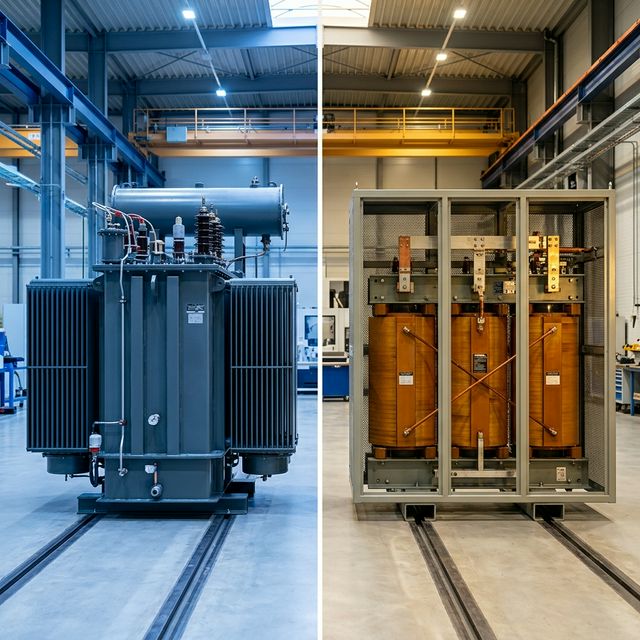
Choosing between oil-immersed and dry-type transformers is one of the most important decisions in power distribution system design. This guide breaks down the key differences to help you make an informed choice.
Construction and Cooling
Oil-immersed transformers use mineral oil both as a coolant and insulating medium. The core and windings are submerged in oil inside a sealed steel tank, with heat dissipated through radiator fins or forced oil/air cooling systems.
Dry-type transformers rely on air for cooling and use solid insulation materials like epoxy resin or varnish. No liquid coolant is required, making them inherently safer for indoor installations.
Performance Comparison
| Feature | Oil-Immersed | Dry-Type |
|---|---|---|
| Capacity Range | 30 – 500,000 kVA | 30 – 35,000 kVA |
| Voltage Class | Up to 765 kV | Up to 35 kV |
| Efficiency | 99.0 – 99.7% | 98.5 – 99.5% |
| Noise Level | 40 – 60 dB | 45 – 65 dB |
| Service Life | 25 – 35 years | 20 – 30 years |
| Maintenance | Regular oil testing | Minimal |
| Fire Risk | Higher (flammable oil) | Very low |
| Installation | Outdoor or vault | Indoor (close to load) |
When to Choose Oil-Immersed
- High-capacity applications (above 2,500 kVA)
- Outdoor installations with adequate clearance
- Cost-sensitive projects (lower initial cost per kVA)
- Utility-scale distribution networks
- Applications requiring very high voltage ratings
When to Choose Dry-Type
- Indoor installations (hospitals, data centers, malls)
- Fire-sensitive environments
- Underground or enclosed spaces
- Locations near human activity
- Where environmental contamination risk must be eliminated
Total Cost of Ownership
While dry-type transformers have a higher upfront cost (typically 15-30% more), they often have lower total cost of ownership due to:
- No oil maintenance — no oil testing, filtering, or replacement
- No containment — no oil bunding or fire suppression systems needed
- Closer to load — reduces cable runs and associated losses
- Insurance benefits — lower premiums due to reduced fire risk
VoltBridge Recommendation
For outdoor distribution networks and high-capacity applications, our S11/S13 oil-immersed series offers the best combination of efficiency, reliability, and value. For indoor, fire-sensitive, or environmentally critical installations, our SC(B) dry-type series delivers maintenance-free performance with Class F/H insulation.
Contact our engineering team for a detailed techno-economic comparison tailored to your specific project requirements.